
Suakin — Toroidal Designer

An engineering intelligence layer over simulation for UAV design, starting with toroidal propellers for quadrotors.

A design engine with memory, governance, and reproducibility guarantees — delivered as an API.

It is not a simulation tool, not an LLM wrapper, and not a CAD frontend.

Open Toroidal Designer Contact Us for Enquiry

The Toroidal Designer

Parameters in, validated B-rep out — with the geometry visible at every stage.
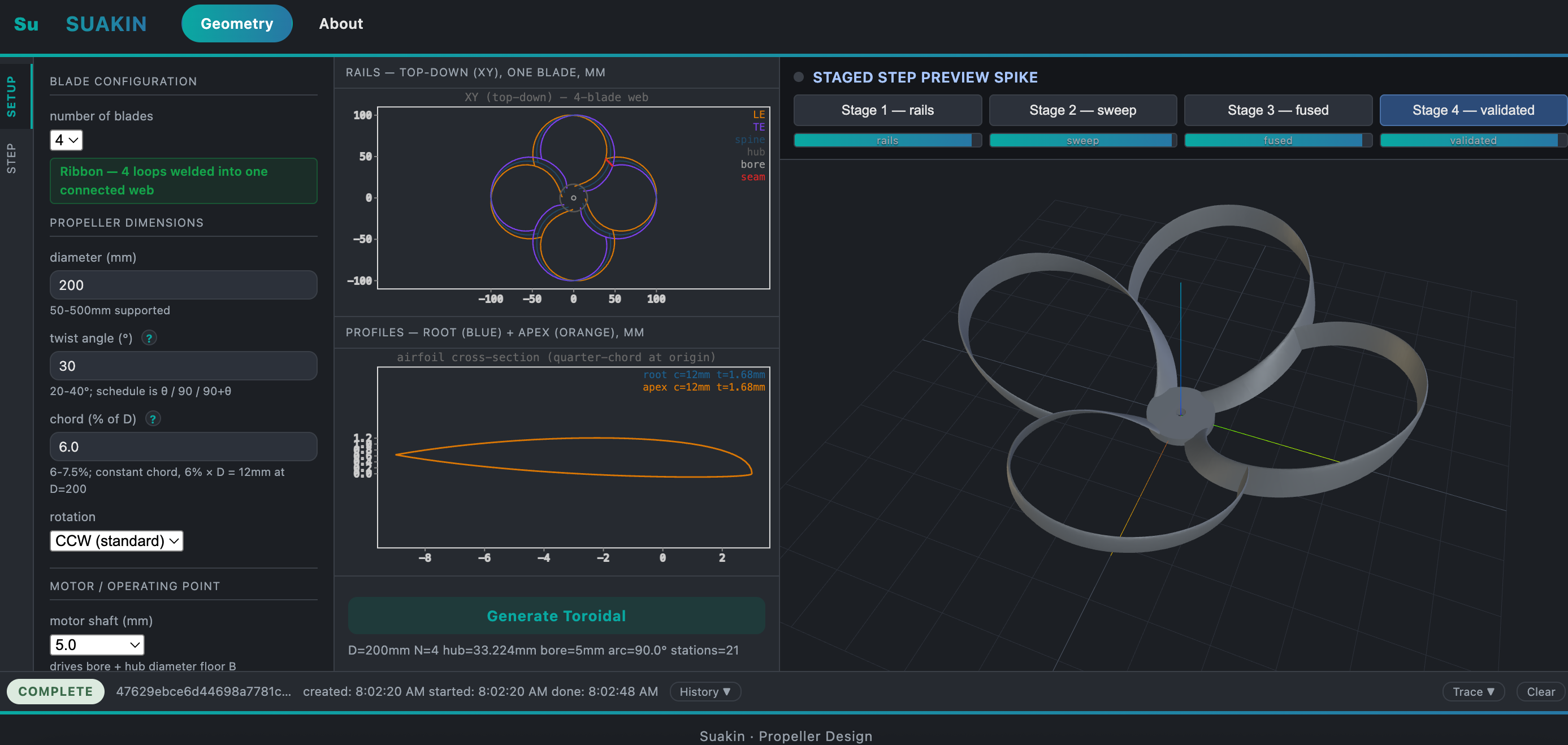
Suakin Toroidal Designer interface showing blade configuration inputs, top-down rail plot, airfoil cross-section, staged STEP preview, and the generated four-loop toroidal propeller
Blade configuration and propeller dimensions on the left; rail and airfoil-profile plots in the centre; the staged STEP preview — rails, sweep, fused, validated — rendering the closed-loop B-rep on the right.

Who It Is For

Solo engineers, UAV startup teams, and small drone companies — people who need a disciplined, reproducible workflow without enterprise bureaucracy. Structural and small aerospace R&D teams are a later audience.


What Works Today

The honest list. Everything here is built and in use.

  • Built — Toroidal propeller geometry generation. Closed-loop B-rep, exported as STEP in four progressive stages (rails, sweep, fused, validated).
  • Built — B-rep-only validity: OCP topology, watertight shells, and a Euler–Poincaré genus gate. No tessellation, because a mesh can read watertight while the underlying B-rep is not.
  • Built — Graph-driven job pipeline across control / data / execute blocks, with surfaces as contract injectors and job state in Firestore.
  • Built — Station-count policy, served at GET /policies/toroidal_stations.
  • Built — Aerodynamic feasibility check (M1–M6) at POST /validate/design. Informational; it does not gate generation.

The MVP does one thing

Generate a valid toroidal propeller B-rep and emit it as STEP. Everything below the geometry line is deliberately deferred until that is solid: the open-blade comparator, CFD evaluation, thrust and efficiency metrics, acoustic proxies, surrogate models, and optimization loops.

What Is Planned, Not Built

Stated plainly so nobody plans around something that does not exist yet.

  • Planned — Run manifests. Every job emitting its exact inputs, policy bindings, solver version, container hash, seeds, and output hashes — the contract of truth for reproducibility.
  • Planned — Policy layer. Versioned solver, mesh, compute, design, and objective policies, with approval gates and budget limits. Today the registry holds station counts only.
  • Planned — CFD evaluation. RANS-based thrust, torque, and efficiency, plus an acoustic proxy for the toroidal-vs-baseline noise comparison that motivates the geometry.
  • Planned — Surrogate models and bounded optimization, with CFD confirmations limited by an explicit compute budget.
  • Planned — Multi-tenancy. Tenant and project scoping on every artifact, with no cross-tenant joins or shared retrieval memory.
  • Planned — Open-blade comparator for like-for-like toroidal vs conventional studies.

Principles the System Is Built On


Further Out

Frame structural integrity, payload integration, energy modelling, and full mission-envelope optimization, with design-to-manufacture constraints for toroidal printability throughout. The destination is a governed engineering operating layer for UAV system design, combining physics-based simulation, learned models, and controlled optimization under explicit policy and cost bounds.

What It Refuses to Be

  • A black-box optimizer
  • A generic CFD hosting service
  • A chat wrapper for engineering
  • An uncontrolled auto-design generator
  • A no-code physics sandbox

Engineering credibility is mandatory.


Access

Try the Toroidal Designer directly, or get in touch to discuss access, design parameters, or integration with an existing simulation workflow.

Open Toroidal Designer Contact Us for Enquiry